Liberté.

On June 14, 1940, German Nazi troops marched into Paris, and the city fell to German occupation. Only days before, the embattled Prime Minister of France, Paul Reynaud, had declared Paris an Open City in a last-ditch effort to save it from destruction, thereby allowing soldiers to march in unhindered.
I have heard many jokes about the French surrender since moving to France, surprisingly coming from French people themselves (“How many Frenchmen does it take to defend France?” “Nobody knows, it’s never been done before” etc., etc.).
Whether this is their version of self-deprecating second degré humor (a particularly French brand of humor that is intended to be subtly ironic), or a remnant of anti-French sentiment that crossed the ocean from America during the Iraq War, I have been told these jokes over and over, by French colleagues and French friends, over apéro and coffee, whenever the topic of World War II comes up.
The truth, of course, is far more complex than the French simply kneeling and giving up their country to an incoming fascist force. In this (very long) post, I am going to take a break from my own personal stories to recount some of the most significant dates and events that unfolded in France during WWII. For me, this is a critical part of living in France; understanding the why of how things transpired reveals so much about modern-day France, French culture and politics, and the world at large.
For such a heavy topic, it is impossible to know where to begin, but I find things start to get really interesting with the Mechelen Incident, which may very well have completely changed the course of the war (and directly refutes that France was sitting idly by and doing nothing while the threat of Germany grew).
World War II is considered to have begun officially when Germany invaded Poland in September 1939. Immediately after their invasion on the 1st of September, France and Britain formally declared war on Germany on the 3rd of September. This was also known as the Phoney War, as there was almost no military action against Germany from either France or Britain for some time.
On the 10th of January 1940, a German pilot commandeering an aircraft with a fellow officer aboard, miscalculated where he was due to heavy fog; instead of landing in Cologne, where the officer needed to go (and normally would take a train) and where the pilot had intended to drop off his laundry to his wife, they crash landed in neutral Belgium. It is still not clear why they crashed; it was likely due to a cockpit error the pilot made of accidentally cutting off the plane’s fuel supply, probably in confusion while flying through fog.
Normally, this would have been an uneventful plane crash due to a pilot's mistake, with maybe some mild side-eye from Belgium, since they were a neutral country during wartime Europe. But only when the pilot and officer were told by a local farmhand that they had, in fact, landed in Belgium and not Germany, did the officer reveal the truth to the pilot: He was carrying highly sensitive and classified documents detailing Hitler’s plan to soon invade Belgium, the Netherlands, and Luxembourg.
It gets even crazier from there in a series of almost comical mishaps: The German officer’s lighter failed to work, and he could not burn the secret papers in time; they were then quickly captured by Belgian border guards who arrived on the scene almost immediately. Then, while at the Belgian guardhouse, the officer tried lighting the papers on fire again after feigning he needed the toilet and stuffing them in a nearby stove, but then failed again when he drew attention by yelling when he touched the searing-hot lid to the stove. The papers were miraculously saved by the Belgian guards.
Against all odds, enough of the papers had remained unburned to show an attack had been planned against Belgium and the Netherlands, although the planned date was not readable. The Belgians then decided to trick the German officer into thinking the plans had been burned entirely and were unreadable, and “allowed” him to pass this information back to the Germans in an effort to circumvent their knowledge that Belgium had now been alerted to Hitler’s plans.
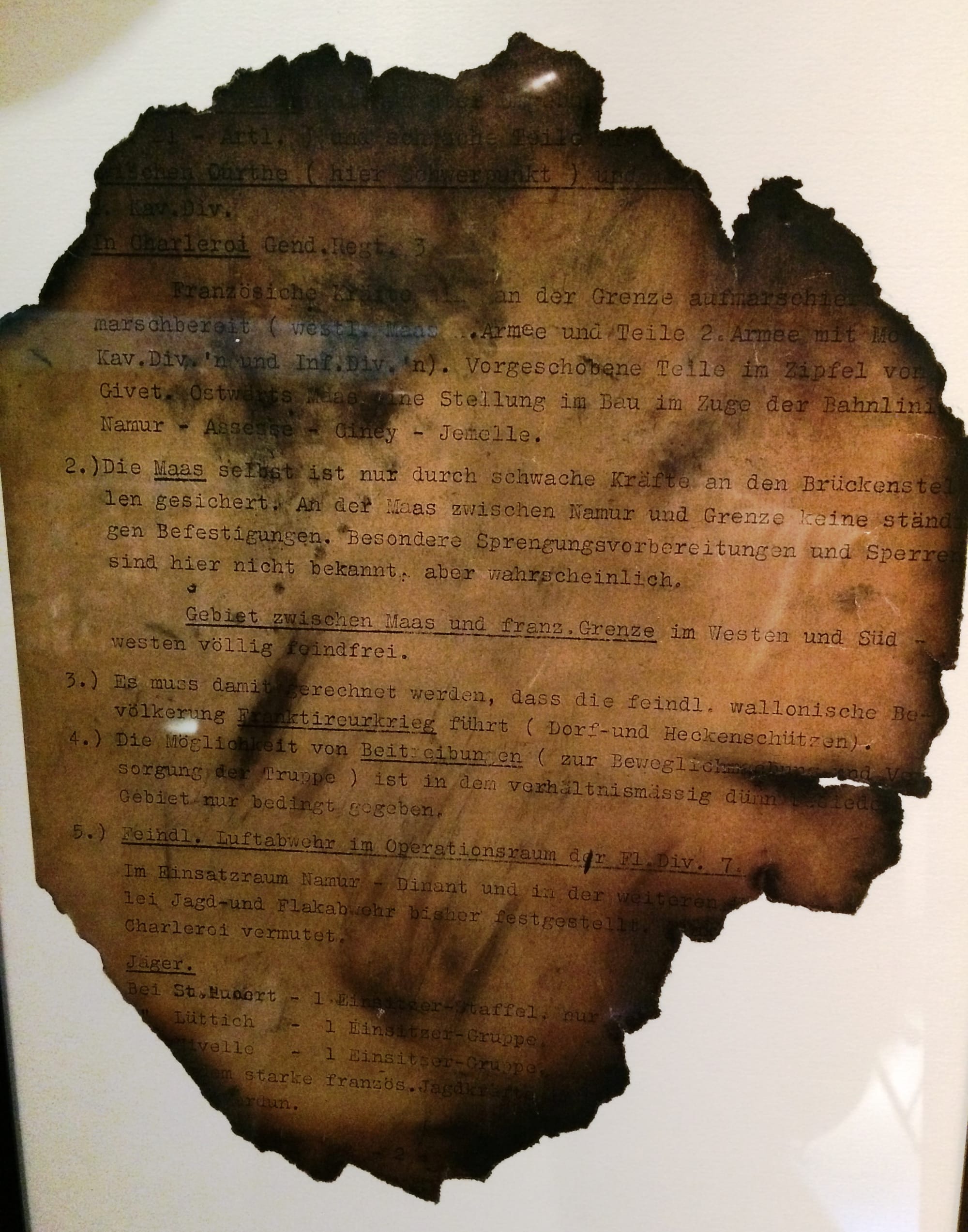
King Leopold III of Belgium was notified of the plans and immediately informed Maurice Gamelin, who was the head of the French army, as well as England, the Netherlands and Luxembourg.
And this is where things turn tragic for France.
Gamelin had long wanted to bring French troops to Belgium as a sign of force against Germany and to be prepared for an attack. He was initially correct in this strategy as the Mechelen papers were indeed genuine; French troops in Belgium could have significantly hindered German advances. Gamelin had assumed that the revelation of these plans would spur Belgium to give up its neutrality and allow allied forces in. It even got to the point where he thought he had been given an official “yes” by Belgium, ordered French troops to move to the Belgian border, but had to pull back at the last minute when Belgium confirmed it was staying neutral.
A further series of setbacks took place; Belgium inadvertently alerted Germany that the plans were actually readable when the military advisor to King Leopold III swiftly called in 80,000 Belgian soldiers on leave and simultaneously ordered border barriers to be removed so that British and French forces would quickly be able to come to the aid of Belgium if needed. While German intelligence initially believed the plans were not known, they slightly delayed the attack to see if any new information in the following days would come out, and once they realized Belgian troops were mobilizing (in addition to very heavy snowfall making the planned attack area impassable), Hitler ultimately called off the attack.
The overall implications of this event for the long-term outcome of the war are still debated. But we know that Gamelin had initially been completely correct in his strategy, and not only this, he had actively been trying to convince neutral Belgium and the Netherlands that the threat from Germany was very real, and that they urgently needed to align with England and France.
Tragically, the Mechelen papers would serve as classic confirmation bias for Gamelin. The grave erreur that was made on the part of France was to assume Germany would stick to the original plan, despite their knowledge that the plans had been discovered, and conduct predictable, methodical advances in the north through Belgium. Gamelin did not calculate that the Germans would restrategize for an attack that was unthinkably bold for known German tactics at the time: they would lure the most capable and well-armed Allied troops to the north, keeping them busy in Belgium, while they advanced in the south, through Ardennes, otherwise known as the infamous Manstein Plan.
The result was catastrophic: When the Germans did finally attack in May 1940, the most capable Allied troops got trapped in the north, fighting the Germans sent there as a diversion, and were physically divided, unable to stop the real German advancement in the south.
Both Reynaud and Gamelin had been critically aware of the threat of Germany to Paris and France, and Europe at large. Reynaud had been staunchly against the Munich Agreement of 1938, which allowed Germany to annex parts of what was then Czechoslovakia. His opinion was an unpopular sentiment at the time, and he was also anti-Armistice, refusing to sign the agreement for German occupation after the fall of France on June 22, 1940.
Gamelin’s most criticized mistake, and perhaps the overall mistake of the French Army and French Intelligence at the time, was assuming that Germany would be slow, predictable, and traditional in their strategy, and also incorrectly thinking that the Ardennes region was “impenetrable” and that the Maginot Line could not be crossed.
Neither Gamelin nor Reynaud fared well after the Germans took over; both were arrested and imprisoned by the Vichy government, then later by the Germans, and only released in 1945, in the final battles of the war.
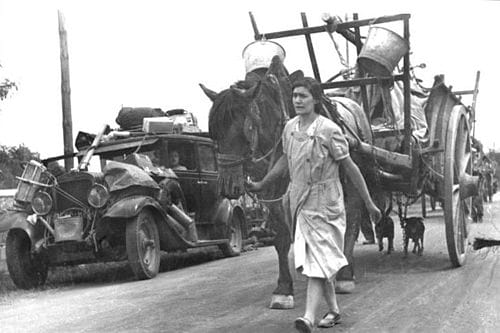
While German soldiers advanced closer and closer to Paris, panicked Parisians left in droves, resulting in a mass exodus of two million people from the city, leaving a rather deserted and undefended Paris for the Germans to take over. To add to this, an unfathomably large number of other civilians from areas outside of Paris, mainly French but also including Belgian refugees, took to the main thoroughfares of northern France in an attempt to escape the incoming Germans, clogging the main roads and tragically slowing down the French army even more. The total number is estimated to be between 8 and 10 million people, who were also weaponized as human shields by the Germans to further block the French defense.
While initial testimonies reported that the occupying German soldiers in Paris were relatively well-behaved and well-mannered, and while most French were initially hopeful things would remain the same with Vichy France, as it was now technically “neutral,” German occupation and the supporting Vichy government quickly became an unbearably painful experience for the French, and a dark mark on French history.
The country was carved up into pieces: Alsace and Moselle directly became part of the German Reich, its inhabitants now forbidden from speaking French and its men forced to fight on the German front; the north was occupied by Germans, the south occupied by the Vichy government, which was authoritarian and actively collaborating with the Nazis, and Mussolini’s Italy took a piece of the southeast.
Deportations began immediately, upwards of two million French soldiers were sent to Germany and made to work forced labor. As part of the Armistice “agreement,” France had to pay for its own occupation, an exorbitant sum of money, and an artificial exchange rate was created by the Germans for the Reichsmark vs the franc, leading to massively inflated prices for everyday goods and a 20% devaluation of the franc.
With the addition of strict rationing implemented by the Germans, people began to go hungry and malnutrition skyrocketed. Curfews were enacted, propaganda was forced on the population, dissidents were brutally shot, and civilian massacres routinely took place. Germans further plundered the country, stealing art, renaming buildings, and causing fuel shortages. Electricity blackouts became common, leaving the City of Light in pitch darkness.
Anti-Jewish sentiment had already been present in France long before the war, and the highly antisemitic Vichy government seized on the opportunity: Without prodding from the Germans, they enacted strict laws stripping Jewish citizens of their rights, and ordered French police to begin capturing Jewish civilians. An estimated 75,000 Jews were deported to concentration camps, of which an estimated 72,000 were killed, the majority of which were foreign Jews that had attempted to come to France for safety.
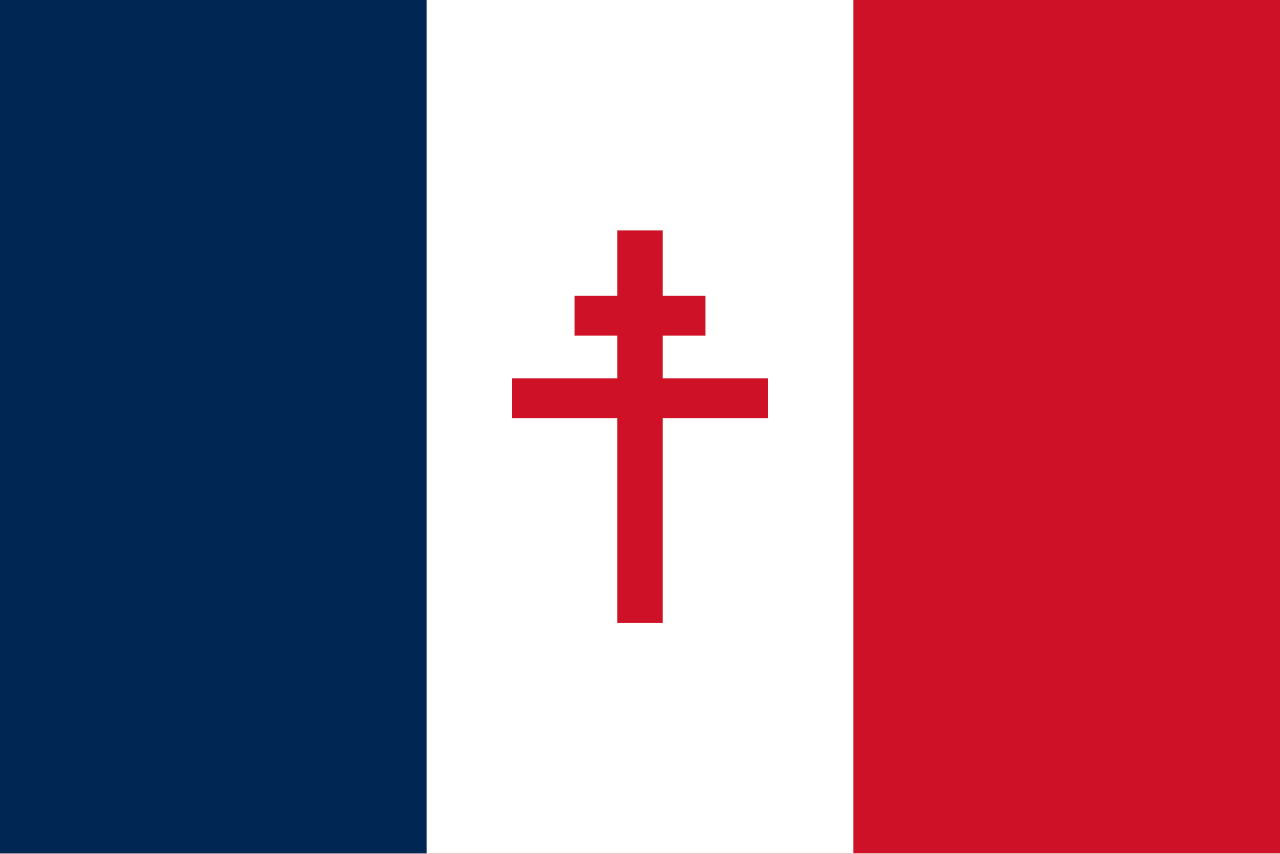
While official French Resistance members are estimated to have, at most, only been about 3% of the population, they were remarkably effective in sabotaging the occupation. By June 1944, they had effectively created their own paramilitary group of 100,000 fighters known as the French Forces of the Interior and joined forces with Charles de Gaulle’s Resistance government, Free France (France libre). The Resistance was represented by the iconic tricolore flag, newly decorated with the Cross of Lorraine, a historic symbol of the French provinces lost to the Third Reich.
Resistance fighters have often spoken of a defining moment where they knew they could no longer tolerate the German occupation, from seeing the violence inflicted on their fellow citizens, to the mutual collective shock of seeing French flags around Paris replaced with the Nazi swastika flag, including one hoisted over the Eiffel Tower.
They did everything they could: Small acts of sabotage like slashing Nazi vehicle tires and cutting phone lines, publishing and distributing underground newspapers at enormous personal risk that spread vital information and significantly boosted French morale, relaying intelligence to Allied forces, and helping Jews escape. They established safehouses to create secret escape routes to safe countries for downed Allied airmen, escaped prisoners, and Jews. Rural guerrilla bands called the Maquis, comprised mostly of the young men who resisted capture to be sent to forced labor in Germany, used guerrilla tactics to agitate the Vichy militia and occupying German soldiers.
Notably, the Resistance was comprised of people from virtually every background, from aristocrats to humble students, with widely varying ideologies, united by a mutual hatred of the occupation and Vichy government. And while official members are estimated to be at the low end of the total population, small acts of resistance from the civilian population were widespread; one of my favorite examples being from French wineries.
The post-Armistice division of France had "conveniently" allowed Germany to control France’s most renowned wine regions, where they quickly enacted a system of export, sending out the very best wines France had to offer to their own population in Germany as well as their own troops, in an effort to boost morale and “fuel” their soldiers. While “complying,” French vignerons famously began to hide their best wines behind makeshift bricked-up walls, some of these hidden stashes only rediscovered decades after the war had ended. Even the German wine experts, appointed by the occupying officers to oversee the distribution of French wine to Germans, had sympathy for the French winemakers, sometimes even aiding the subtle sabotage by not reporting mislabeled wine or disappearing bottles.
But the Resistance, due to the threat and persistent violence of the occupying German forces and the Vichy government, was also pained with complicated setbacks. Notoriously, a significant number of French civilians betrayed each other to German occupiers, much to the surprise of the Germans. The Resistance groups were also numerous, highly fractured, and often ideologically opposed and suspicious of each other.
The extraordinarily brave Jean Moulin, a key figure of the Resistance and today considered a hero of France, was appointed by Charles de Gaulle himself, then in exile in England and attempting to lead the Resistance from abroad, to unify all the fractured groups. Tragically, Jean Moulin was mysteriously betrayed (it is still a matter of great speculation who betrayed him), arrested by the German Secret Service, brutally tortured and killed, all while famously revealing no information.
In 1944, the French Resistance reached its peak effectiveness for D-Day. The French Resistance fighters collaborated extensively with British and American personnel to severely damage or destroy all French rail systems, power lines, phone lines, fuel depots, roads, and German command posts in the weeks before the Normandy invasion. Reportedly, the French phone system became so unusable that the Germans were forced to use the radio, allowing the Allies to listen in.
Perhaps most valuably, they also communicated and passed on an enormous amount of intelligence that directly contributed to the success of the Normandy landings for the Allies. Additionally, at this point, the Maquis were much more armed (aided by persistent weapons drops from Allied forces) and actively fighting the Vichy militia. Thanks to these coordinated efforts, German forces struggled to mobilize during perhaps the most critical point of the war.
Not long after the success of D-Day and Allied forces advancing, on August 15, 1944, Parisian policemen, who were until then part of Vichy, went on strike in Paris (not even Nazi-occupied Paris was immune to French strikes).
On August 19, suddenly joining forces with the Resistance and as a dramatic act against the occupying Germans, they lifted the tricolore French flag over the Préfecture de Police. The French flag had not been visible since June 1940.
This caused a domino effect all over Paris: Suddenly, other government establishments, police stations, and schools hoisted the flag over their buildings, a powerful symbol of defiance against the occupation and a signal that the tide was turning. The police strikes paved the way for a full-blown insurrection on the 19th of August, led by the Resistance groups who had now partnered with the Paris police, attacking German forces and leading to barricades being set up by Parisian civilians all over Paris, ensuing in a fierce, multi-day battle for the city.
Hitler famously ordered the German General Dietrich von Choltitz to go scorched earth, saying, “Paris must be destroyed from top to bottom…do not leave a church or cultural monument standing.” Explosives were actually laid at key cultural areas; the city was primed to be reduced to rubble.
While Parisians love to say that Choltitz had declined to follow Hitler’s orders because he felt “Paris is too beautiful to be destroyed,” the actual truth may be more nuanced. Choltitz knew that with only 20,000 relatively unmotivated men to command, it was a losing battle against the uprising of Parisian civilians, the Resistance, and advancing Allied forces; in addition, it is speculated he may have also declined to curry favor for staying alive and receiving better treatment, knowing his capture was likely imminent.
Regardless of his reasons, the explosives were not detonated, the city was not destroyed, and he surrendered on August 25, 1944.
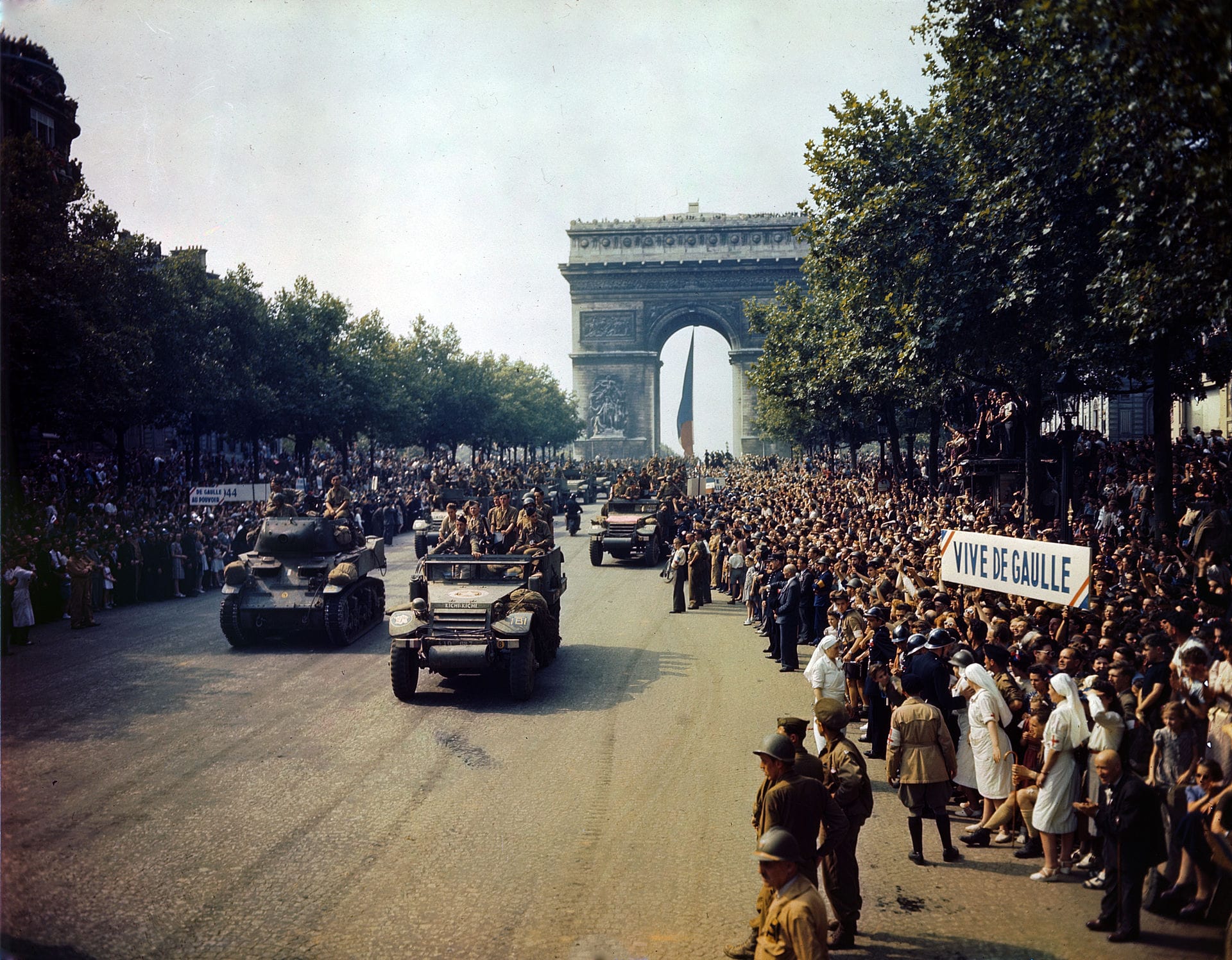
Four years, two months, and eleven days after German troops first marched in, Paris was liberated. On the 29th of August, American troops arrived in the city and paraded down the Champs-Élysées.
“Paris! Paris is outraged! Paris is broken! Paris martyred! But Paris liberated! Liberated by itself, liberated by its people, with the help of the French armies, with the support and the help of all France, of the France that fights, of the only France, of the real France, of the eternal France!”
Charles de Gaulle, at Hôtel de Ville in Paris on August 25, 1944
The human cost of the occupation and resistance by the French people had been enormous. There are some conflicting numbers, but an estimated 200,000 French citizens were deported from France during German occupation, with an official number of 24,000 Resistance fighters having been killed. There were an estimated 60,300 non-racially-motivated deportations to concentration camps, in addition to the 75,000 Jews deported. It is thought that some 30,000 French civilians had been shot by the Germans in efforts to intimidate the Resistance.
The Germans made violent examples of anyone caught helping the Resistance, the most notorious of which is Oradour-sur-Glane, a small village in Nouvelle-Aquitaine, where all 642 people, 247 of which were children, were brutally and violently murdered for suspected Resistance activity.
In total, France suffered larger civilian casualties than military deaths: 390,000 civilians were killed and 210,000 military personnel lost their lives.
After the war was over, anyone considered a collaborator was swiftly stigmatised, imprisoned, or executed. Perhaps one of the most notorious examples being women who were caught in romantic relationships with German soldiers had their heads shaved and were paraded through towns, an act of utter humiliation. Execution statistics are not reliable; it is believed that at least 10,500 collaborators were executed, and possibly as many as 80,000.
The post-war cultural sentiment was that the Vichy government was an extension and product of the German occupation and not “real” France or representative of its people. The courage of the Resistance was emphasized, and the initial support of the Vichy government was minimized or denied.
Jean Moulin in particular became a revered figure; in 2015, his name was the fifth most popular in France for schools. André Malraux gave a famous speech when Jean Moulin’s ashes were transferred to the Panthéon in 1964: “Today, young people of France, you may think of this man as you would have reached out your hands to his poor, unrecognizable face on that last day, to those lips that never let fall a word of betrayal: On that day, his was the face of France…”
It was only much later, that the more nuanced truth was discussed: A major hindrance for the Resistance had been the sheer volume of denunciations given by the French people to German occupiers; denunciation letters sent are estimated to be at somewhere between 3 and 5 million, an enormous amount. Even the Germans had been taken aback at the ease with which French people seemed ready to betray each other.
In addition, for decades after the war, no French president recognized the Vel' d’Hiv' roundup. Perhaps the most infamous among numerous mass arrests of Jews, the Vel' d'Hiv' roundup was the arrest of 13,152 Jews, including 4,115 children, who were taken and deported to death camps.
In 1994, François Mitterand, then President of France, said in regards to the Vichy government, “The republic had nothing to do with all that. I do think that France is not responsible. Those who are accountable for those crimes belong to an active minority who exploited (French) defeat. Not the Republic and not France. I’ll never ask for forgiveness in the name of France.”
It is an uncomfortable truth, and only acknowledged in more recent years, just how widely supported the Vichy government was, and that it was in fact the Vichy government, with the notorious Philippe Pétain at the helm, that enacted severe anti-Jewish legislation without any prompting from the Germans.
It was only in 1995 the newly elected President Jacques Chirac gave a speech commemorating the Vel' d’Hiv' roundup and commented on France's role: “It is true that the criminal insanity of the (German) occupying forces was supported by some French people and the French state…France, the land of the Enlightenment and of Human Rights, land of the hospitality and asylum, France, on that day, committed an irreparable act. It failed to keep its word and delivered those under its protection to their executioners.”
Subsequent Presidents Hollande and Macron followed suit, each acknowledging that the Vichy government and crimes committed at this time were by France.
It is also understood that French sentiment toward the Vichy government and the German occupiers changed dramatically around 1942; French citizens had now witnessed brutal violence and numerous deportations, and it is thought that even the previously anti-semitic French were shifting their attitudes.
It is also worth bringing up at this time, perhaps one of the most profound statistics of the war: 75% of France’s Jewish population survived, one of the highest rates in Nazi-occupied Europe. The reasons for this have long been debated and studied, and are complex.
It is not a simple matter of Jews having been saved by their non-Jewish neighbors, but rather a combination of factors: In addition to the French civilians who courageously tried to help their Jewish neighbors, there were large swaths of rural areas and remote villages ideal for hiding, tolerance towards the Vichy government changed over time, there was significant Jewish self-rescue and survival, and there existed an unoccupied zone with less roundups.
Jacques Sémelin has extensively studied the paradox of a population that was initially supportive of the Vichy government and the high Jewish survival rate in France in his book, The Survival of Jews in France, 1940-44.
Eliza Luft, an Assistant Professor of Sociology at the University of California, writes an excerpt: “For Sémelin, that explanation comes down to the French population and French culture itself: French patriotism, the Republican tradition, and Christian (especially Catholic) religious values endowed French civilians with a sympathy for Jews that, coupled with various structural factors (e.g., the hybrid nature of its occupation), served as a bulwark against the Nazis’ genocidal project, even within the Vichy government, and even when it initiated its own antisemitic policies…In fact, undergirding’s Sémelin’s thesis is the argument that more Jews survived the Holocaust in France than elsewhere because they were treated, for the most part, like anybody else: With acceptance and compassion rather than as threatening outsiders, despite Vichy and the Nazi’s attempts to characterize them as a subhuman mass.”
Today, nearly 80 years after the war ended, the mass suffering and deaths that occurred are commemorated by war memorials all over France, including in Paris, stark reminders of the horrors that took place.
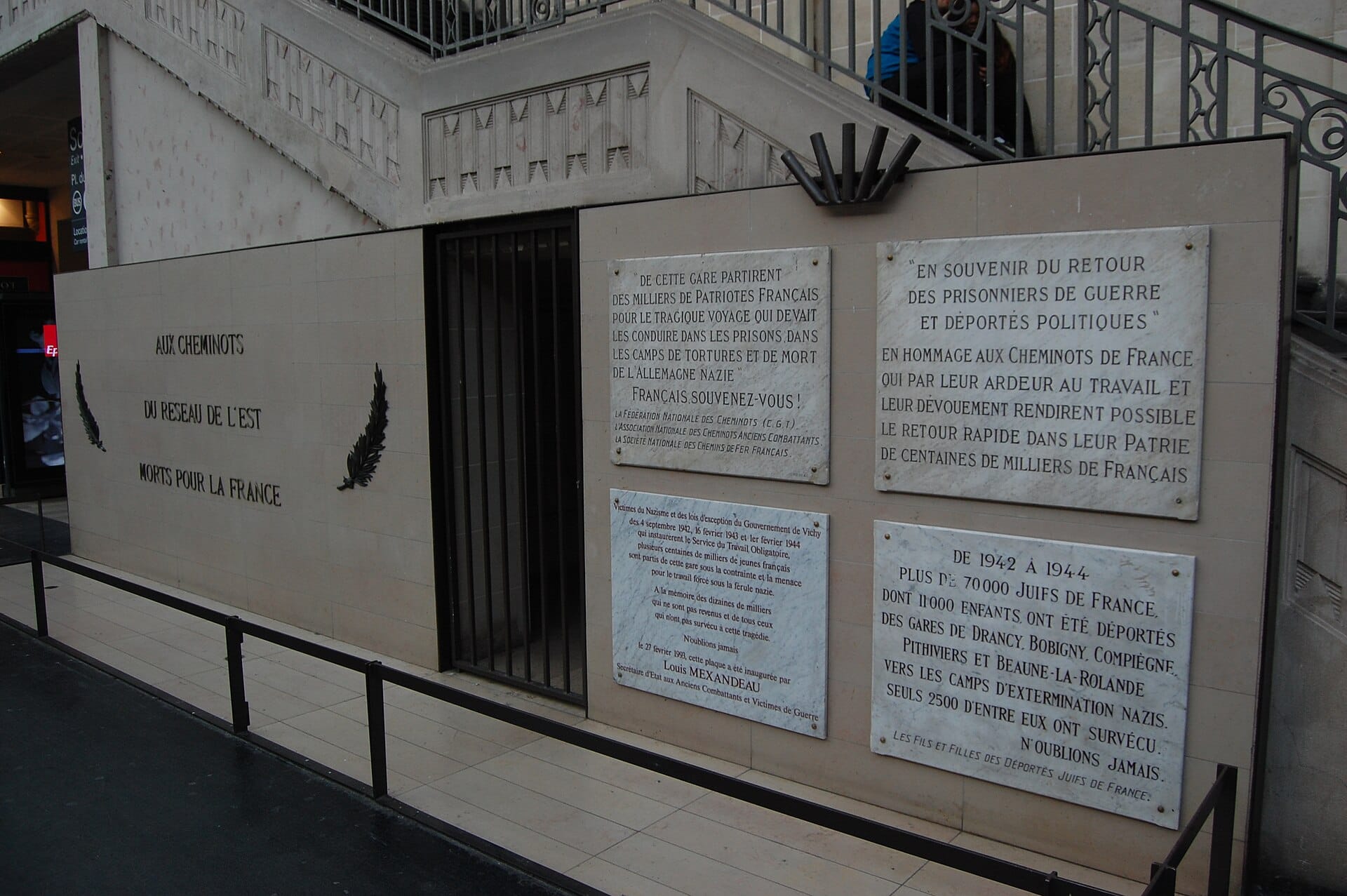
At Gare de l’Est, one of the main train stations in Paris with trains departing for the east of France and Germany, large plaques are cordoned off with inscriptions reminding people that this train station took part in mass deportations during the war. It is a chilling visual that this was the last place countless innocent people saw before they were deported to concentration camps to their deaths, while hundreds of tourists blithely stream around today. An actual bunker remains under the train station.
There is so much more I could write on what occurred during these times. WWI was brutal for the French people and caused mass trauma; nearly two million French citizens, both military and civilian, were killed, perhaps contributing to the collective sentiment in the early days of WWII occupation to support those in power and side with the aggressor in an effort to minimize violence. An entirely separate but equally important topic is how North Africa and the French Caribbean played a role in the Resistance, protecting and rescuing Jews and helping the fight against Nazi Germany, and the failure on the part of France to acknowledge and properly commemorate their part in the war. The extent of French support for the Vichy government continues to be hotly debated and remains a pertinent question for current-day politicians.
Today, the threat of fascism continues. Echoing Gamelin’s mistake after the Mechelen Incident, it would be wrong to assume that fascism is methodical, predictable, easy to outmaneuver. It has to be acknowledged how insidious it is; a slow creep until it abruptly turns into an explosion of chaos, violence and oppression nearly overnight. It is also critical to understand and remember the series of events leading up to a fascist takeover, what actually caused the Fall of France, and to look at the surviving images and videos of those times in relation to the global issues we struggle with today.
Long before the Second World War, France lost the Franco-Prussian War, leading to the collapse of the Second French Empire; the Church and State were officially separated soon after, and several scandals took place, notably the Dreyfus Affair, laying the groundwork for a dramatic increase in antisemitism and far-right nationalism in France.
Videos of the 1940 mass exodus of French citizens when the Germans marched in look eerily similar to images we see on the news today: Shell-shocked children staring vacantly at the camera as they follow a wagon piled with their family’s life belongings, their parents staring grimly ahead as they slowly move down the road in a long line with hundreds of other refugees. Photos of the internment camps in France, put in place by the Vichy government and that were the last stop for rounded-up Jews before concentration camps, show countless cots squeezed together, women and children lying on top, bundled up in the only clothing they were allowed to keep.
I think for most of us today, the world feels increasingly unstable; we are all watching the news with collective alarm and have mutual anxiety regarding current events. I find it imperative to understand the past as best as I can, to understand the events that led to the unthinkable, to be able to draw the parallels necessary to know how to act today.
For France, when the Germans marched in, they were a nation still recovering from the First World War and experiencing a new period with a national identity in flux, without monarchy and church in the government. There were French people looking to an egalitarian future without the extreme class differences of the past, and there were those who wanted to return to tradition and faith.
Beyond any doubt, there were a significant number of French citizens who committed extraordinary acts of bravery during WWII, whether it was actively fighting in the Resistance or simply protecting a neighbor. And there were also those who denounced their peers to the occupiers and assisted in the genocide against Jews.
France’s ongoing grapple with its role during WWII reflects the same questions we should all be asking ourselves today: Where will I stand to protect the rights and dignity of my fellow humans? How can I resist against fascism today?
And of course, as I mentioned at the beginning of this blog as so many French people do today, there is always the option of self-deprecating humor to allow ourselves to laugh about an infinitely complex and difficult time in this country’s past, where fighting against the oppressor felt impossible.
But still, it has to be done.
I would like to humbly note that I am not a historian, nor an expert on WWII, and certainly not an expert on France and its history. I have done my best to include only facts and accurate statistics, largely sourced from Wikipedia, however, if there are any inaccuracies due to personal errors or otherwise, I apologize and would be happy to be corrected.
Below are listed all the websites and sources I used in the writing of this post, and I highly encourage you to do further reading if this topic interests you; there is a vast amount of information that is absolutely impossible to cover in its entirety in a single blog post.
- https://en.wikipedia.org/wiki/Mechelen_incident
- https://en.wikipedia.org/wiki/Maurice_Gamelin
- https://en.wikipedia.org/wiki/Paul_Reynaud
- https://en.wikipedia.org/wiki/Munich_Agreement
- https://en.wikipedia.org/wiki/Maginot_Line
- https://en.wikipedia.org/wiki/Manstein_plan
- https://en.wikipedia.org/wiki/Paris_in_World_War_II
- https://en.wikipedia.org/wiki/French_Resistance
- https://en.wikipedia.org/wiki/Military_history_of_France_during_World_War_II
- https://en.wikipedia.org/wiki/Charles_de_Gaulle
- https://en.wikipedia.org/wiki/National_Front_(French_Resistance)
- https://en.wikipedia.org/wiki/Maquis_(World_War_II)
- https://www.francechannel.tv/Blog/FrenchCulture/History/The-Secret-Bunkers-of-Paris-WWII-Resistance-and-Underground-Networks
- https://www.bbc.com/travel/article/20240605-how-french-winemakers-outwitted-the-nazis
- https://en.wikipedia.org/wiki/Jean_Moulin
- https://en.wikipedia.org/wiki/Liberation_of_Paris
- https://en.wikipedia.org/wiki/Dietrich_von_Choltitz
- https://www.history.com/this-day-in-history/august-25/paris-liberated
- https://www.emersonkent.com/speeches/paris_liberated.htm
- http://www.mheu.org/en/timeline/malraux.htm
- https://www.sciencespo.fr/mass-violence-war-massacre-resistance/en/document/chronology-repression-and-persecution-occupied-france-1940-44.html
- https://www.iwm.org.uk/history/spies-saboteurs-and-d-day
- https://en.wikipedia.org/wiki/Oradour-sur-Glane
- https://en.wikipedia.org/wiki/Bombing_of_France_during_World_War_II
- https://en.wikipedia.org/wiki/World_War_II_casualties
- https://quod.lib.umich.edu/w/wsfh/0642292.0031.017/--denunciations-community-outsiders-and-material-shortages?rgn=main&view=fulltext#N3
- https://en.wikipedia.org/wiki/Vichy_anti-Jewish_legislation
- https://en.wikipedia.org/wiki/Pursuit_of_Nazi_collaborators
- https://en.wikipedia.org/wiki/Vel%27_d%27Hiv_roundup
- https://en.wikipedia.org/wiki/Fran%C3%A7ois_Mitterrand
- shttps://www.levendel.com/En/html/chirac-s_speech.html
- https://www.sciencespo.fr/en/news/jacques-semelin-on-his-book-the-survival-of-the-jews-in-france/
- https://www.sciencespo.fr/research/cogito/home/the-survival-of-the-jews-in-france-1940-1944/?lang=en
- https://muse.jhu.edu/article/803537
- https://www.memorializieu.eu/en/history/why-were-there-jewish-children-in-izieu/